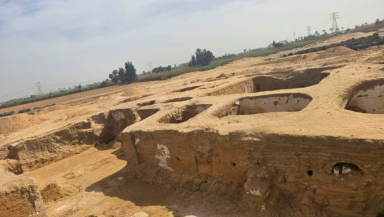
Egyptian archaeologists have unearthed a 1,500-year-old monastic complex in the Nile Delta, including a fifth-century building believed to have served as a reception facility for pilgrims, Egypt’s Ministry of Tourism and Antiquities announced.
The discovery was made at the Al-Qalāyā site in Beheira Governorate, where an Egyptian mission from the Supreme Council of Antiquities has been excavating since 2023, according to the announcement.
Officials called the find significant for understanding the origins of organized monastic life.
The newly uncovered structure contains 13 rooms that served multiple functions, including individual and communal monastic cells, spaces for hospitality and education, a kitchen, and storerooms.
Architectural elements added during later historical periods were also identified, indicating the building was modified and repurposed across subsequent phases of use.
A large hall in the northern section of the building features stone benches decorated with botanical motifs and was likely used to receive visitors, including senior monastic figures and those seeking to study monastic life. The building extends along a north-south axis, with a prayer room oriented to face east. A limestone-carved cross is set within the eastern wall.
Hisham El-Leithy, secretary-general of the Supreme Council of Antiquities, identified Al-Qalāyā as the second-largest known monastic gathering site in the history of Christian monasticism. He said its architectural style reflects “the earliest nucleus of monastery establishment.”
El-Leithy said the decorative motifs and illustrations found at the site are among the most significant sources for the study of early Coptic art, offering historical and archaeological evidence about the nature of monastic life and artistic development in its earliest stages.
The discovery also shows the evolution of monastic architecture from solitary dwelling to communal housing and, ultimately, to facilities designed to receive visitors, he added.
Wall paintings recovered from the site depict monks, identifiable by their clothing, alongside geometric and plant-based decorations. These include braided ornaments in red, white, and black, as well as an eight-petaled flower. Officials said the works point to the richness of symbolic expression in early Coptic art.
One prominent mural shows two gazelles surrounded by vegetal motifs within a double circular frame, which is believed to carry symbolic meaning, Basilica News Agency reported.
The site offers evidence of a transition from eremitic life, in which monks lived in isolation, to communal monastic organization. The development occurred in a region distinct from the desert areas of southern Egypt, which have long been regarded as the cradle of early monasticism.
A complete marble column measuring 2 meters in length was also recovered, along with column capitals and bases. Pottery fragments bearing vegetal and geometric motifs, ceramic pieces inscribed with Coptic letters, bone remains of birds and animals, and a collection of oyster shells were found across the site. The bone remains and shells are consistent with food preparation and daily activities at the complex, according to officials.
Samir Razaq Abdul-Hafiz, head of the excavation mission, said researchers found a rectangular limestone piece at the entrance of one chamber bearing a Coptic inscription. An initial translation suggests the text is a funerary stele. The inscription refers to the death of an individual identified as “Apa Kyr, son of Shenouda,” confirming continued human presence at the site during a period of flourishing monastic development in the region.
Since excavations began in 2023, the mission has also uncovered multiple clusters of monastic cells known as manshubiyyat, groupings of pottery vessels associated with monks’ living quarters. Auxiliary service buildings were also found, indicating the presence of a large and organized monastic center.
Research at the site is ongoing.